

What is Atomic Mass? Atomic mass is represented as the average weight of an atom and also recognized as atomic weight. An atom is composed of three subatomic particles, i.e., protons, neutrons, and electrons, as electrons are very light in weight, so the atomic mass considered as the mass of a total number of neutrons and protons present in the nucleus of an atom. The mass number is the sum of the number of protons and neutrons in an atom. It is a whole number. The atomic mass is the average number of protons and neutrons for all natural isotopes of an element. It is a decimal number. This two minute video shows how to read the periodic table. The terms 'atomic number' and 'atomic mass' are also defined. Find more free tutorials, videos.
Atomic Number vs Mass Number
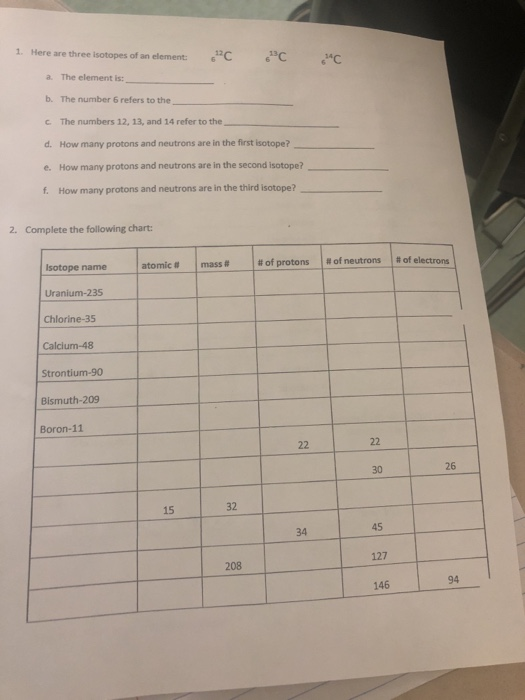
Atoms are characterized by their atomic numbers and mass numbers. In the periodic table, atoms are arranged according to their atomic number. Mass number of an element is more related with the mass of it. However, it is not giving the exact mass of the atom. There are some elements, where atomic number and mass number is similar, and most of the time, mass number is higher than the atomic number.
What is Atomic Number?
Atomic number of an element is the number of protons it has in the nucleus. The symbol for denoting the atomic number is Z. When the atom is neutral, it has the same number of electrons as protons. Thus, atomic number is equal to the number of electrons in this instance. But it is always reliable to get the number of protons as the atomic number. The elements in the periodic table are arranged according to the increasing atomic number. This arrangement has automatically arranged them in increased atomic weight most of the time. Every element has separate atomic number, and no element has the same atomic number. Therefore, atomic number is a convenient way of distinguishing different elements. By looking at the atomic number itself, a lot of information about the element can be withdrawn. For example, it tells the group and the period where the element belongs in the periodic table. Further, it gives information about oxidation states, charge of the ion, bonding behavior, nucleus charge, etc.
What is Mass Number?
Atoms are mainly composed of protons, neutrons and electrons. Atomic mass is simply the mass of an atom. Most of the atoms in the periodic table have two or more isotopes. Isotopes differ from each other by having a different number of neutrons, even though they have the same proton and electron amount. Since their neutron amount is different, each isotope has a different atomic mass.
Mass number is the total number of neutrons and protons in a nucleus of an atom. The collection of neutrons and protons is also known as nucleons. Therefore, mass number can also be defined as the number of nucleons in a nucleus of an atom. Normally, this is denoted in the left, upper corner of the element (as superscript) as an integer value. Different isotopes have different mass numbers, because their numbers of neutrons vary. Therefore, the mass number of an element gives the mass of the element in integers. The difference between the mass number and the atomic number of an element gives the number of neutrons it has.
What is the difference between atomic number and mass number? • Atomic number is the number of protons in a nucleus of an atom. Mass number is the total number of protons and neutrons in the nucleus. • Conventionally atomic number is written in the left, bottom corner of an element, whereas the mass number is written in the left, upper corner. • Atomic number is denoted by Z, and mass number is denoted by the symbol A. |
Related posts:
Main Difference – Atomic Number vs Mass Number
Atoms are composed of electrons, protons, and neutrons. Protons and neutrons together make the nucleus of an atom. When measuring the mass of an atom, we actually measure the mass of the nucleus. That is because the mass of an electron is negligible when compared to a proton or a neutron. The atomic number and the mass number of an atom are two important terms because these terms provide us with details about the number of protons and the number of neutrons present in an atom. The main difference between atomic number and mass number is that the atomic number indicates the number of protons present in an atom whereas, the mass number indicates the sum of the number of protons and the number neutrons present in an atom.
Key Areas Covered
1. What is Atomic Number
– Definition, Explanation with Examples
2. What is Mass Number
– Definition, Explanation with Examples
3. What is the Difference Between Atomic Number and Mass Number
– Comparison of Key Differences

Key Terms: Atom, Atomic Number, Electron, Isotope, Mass Number, Neutron, Nucleus, Proton
What is Atomic Number
Atomic number is the number of protons present in an atom. The protons are in the nucleus of an atom. The number of protons in an atom is a unique property for a chemical element. Therefore, we can identify a given chemical element by finding the number of protons present in its atom. Each and every atom has at least one proton. For example, hydrogen atom has only one proton.
Since the atomic number is the number of protons, the atomic number has no units. For example, the number of protons in Helium is 2. Therefore, the atomic number of Helium is 2. Usually, the atomic number is given along with the symbol of the chemical element in a specific way. An example is given below.
.jpg "Atomic")
Figure 1: The atomic number is given in front of the chemical symbol in a lower case number.
Isotopes are atoms that have the same number of protons but different numbers of neutrons. Since these isotopes have the same number of protons, they belong to the same chemical element. Therefore, when we are talking about isotopes, we are talking about the different forms of the same element.
Protons are positively charged subatomic particles. Therefore, the atomic number indicates the total positive charge of a nucleus. In a neutral atom, the number of protons is equal to the number of electrons, because, in order to be neutral, all the positive charges should be neutralized from the negative charges of the electrons. Therefore, the atomic number is equal to the number of electrons present in a neutral atom.
The atomic number of an element can be changed if that element is radioactive. That is because, when some elements undergo radioactivity, protons are converted into different subatomic particles or neutrons may be converted into protons. Either way, it changes the number of protons present in an atom. This changes into a different element (change in atomic number changes the element).
What is Mass Number
Mass number is the sum of the number of protons and the neutrons of an atom. This means the mass number is the total number of subatomic particles which are present in the nucleus of an atom. A proton or a neutron alone is called a nucleon. Therefore, the mass number can also be given as the total number of nucleons present in the nucleus of an atom.
This is called the mass number because it determines the mass of an atom. The mas of an atom is the total mass of the protons and the neutrons of that atom. That is because the mass of an electron is negligible when compared to a proton or a neutron.
Since the number of protons and the number of neutrons are equal in stable atoms, the mass number of an atom is approximately equal to twice the atomic number. However, in isotopes, the mass number may or may not equal to twice of the atomic number. This is because the isotopes have the same number of protons but a different number of neutrons. Therefore, in those, the mass number is different from that of the expected value.
Figure 2: The major isotopes of hydrogen and their mass numbers.
Apart from that, there are some substances called isobars. These are atoms of different elements that have the same mass number, but they are different in their atomic numbers. For example, Chlorine-37 and Argon-37 have the same mass number. Therefore, they are isobars.
As atoms often undergo alpha decay that eliminates two protons and two neutrons from a radioactive nucleus, the mass number of elements can change accordingly. Then the mass number is changed by 4 units.
Difference Between Atomic Number and Mass Number
Definition
Atomic Number:Atomic number is the number of protons present in an atom.
Mass Number:Mass number is the sum of the number of protons and the neutrons of an atom.
Number of Neutrons
Atomic Number:The number of neutrons does not affect the atomic number of an atom.
Mass Number:The number of neutrons does not affect the mass number of an atom.
Isotopes
Atomic Number: Isotopes have the same atomic number.
Mass Number:Isotopes have different mass numbers.
Atomic Number And Mass Number Pdf
Isobars
Atomic Number: Isobars cannot have the same atomic number.
Atomic Number And Mass Number Answers
Mass Number: Isobars have the same mass number.
Value
Atomic Number:The atomic number is always a smaller value than the mass number.
Mass Number:The mass number is always a larger value than the atomic number.
Conclusion
Atomic number and mass number are fundamental details about an atom. The atomic number is a unique value for a certain chemical element. But there can be elements having the same mass number. They are called isobars. And also, there can be atoms having the same atomic number with different mass numbers yet belonging to the same element. They are called isotopes. The main difference between atomic number and mass number is that the atomic number indicates the number of protons present in an atom whereas, the mass number indicates the sum of the number of protons and the number neutrons present in an atom.
References:
1. “ATOMIC NUMBER AND MASS NUMBERS.” NDT Resource center, Available here. Accessed 13 Sept. 2017.
2. “GCSE Bitesize: Atomic number and mass number.” BBC, Available here. Accessed 13 Sept. 2017.
3. “Atomic number.” Wikipedia, Wikimedia Foundation, 5 Sept. 2017, Available here. Accessed 13 Sept. 2017.
Image Courtesy:
Atomic Number And Mass Number Difference
1. “Blausen 0530 HydrogenIsotopes” By BruceBlaus – Own work (CC BY 3.0) via Commons Wikimedia