
-->
- Rust Visual Studio Support
- Visual Studio Basics
- Rust Visual Studio Code Linux
- Visual Studio Code Rust
- Rust Visual Studio Community
- Vscode Rust
- Rust Visual Studio 2019
In the Overview of developing on Windows with Rust topic, we introduced Rust and talked about what it is and what some of its main moving parts are. In this topic, we'll set up our development environment.
We recommend that you do your Rust development on Windows. However, if you plan to locally compile and test on Linux, then developing with Rust on the Windows Subsystem for Linux (WSL) is also an option.
Install Visual Studio (recommended) or the Microsoft C++ Build Tools
On Windows, Rust requires certain C++ build tools.
Rust Visual Studio Code code completion not working. Ask Question Asked 6 months ago. Active 18 days ago. Viewed 1k times 3. I'm trying to learn Rust and installed the Rust extension for VSCode. But I'm not seeing auto-completions for any syntax. Rust is a curly-brace, block-structured expression language. It visually resembles the C language family, but differs significantly in syntactic and semantic details.
You can either download the Microsoft C++ Build Tools, or (recommended) you might prefer just to install Microsoft Visual Studio.
Note
We'll be using Visual Studio Code as our integrated development environment (IDE) for Rust, and not Visual Studio. But you can still install Visual Studio without expense. A Community edition is available—it's free for students, open-source contributors, and individuals.
While installing Visual Studio, there are several Windows workloads that we recommend you select—.NET desktop development, Desktop development with C++, and Universal Windows Platform development. You might not think that you'll need all three, but it's likely enough that some dependency will arise where they're required that we feel it's just simpler to select all three.
New Rust projects default to using Git. So also add the individual component Git for Windows to the mix (use the search box to search for it by name).
Install Rust
Next, install Rust from the Rust website. The website detects that you're running Windows, and it offers you 64- and 32-bit installers of the rustup tool for Windows, as well as instructions on installing Rust to the Windows Subsystem for Linux (WSL).
Tip
Rust works very well on Windows; so there's no need for you to go the WSL route (unless you plan to locally compile and test on Linux). Since you have Windows, we recommend that you just run the rustup installer for 64-bit Windows. You'll then be all set to write apps for Windows using Rust.
When the Rust installer is finished, you'll be ready to program with Rust. You won't have a convenient IDE yet (we'll cover that in the next section—Install Visual Studio Code). And you're not yet set up to call Windows APIs. But you could launch a command prompt (the x64 Native Tools Command Prompt for VS, or any cmd.exe), and perhaps issue the command cargo --version. If you see a version number printed, then that confirms that Rust installed correctly.
If you're curious about the use of the cargo keyword above, Cargo is the name of the tool in the Rust development environment that manages and builds your projects (more properly, packages) and their dependencies.

And if you really do want to dive in to some programming at this point (even without the convenience of an IDE), then you could read the Hello, World! chapter of the The Rust Programming Language book on the Rust website.
Install Visual Studio Code
By using Visual Studio Code (VS Code) as your text editor/integrated development environment (IDE), you can take advantage of language services such as code completion, syntax highlighting, formatting, and debugging.
VS Code also contains a built-in terminal that enables you to issue command-line arguments (to issue commands to Cargo, for example).
First, download and install Visual Studio Code for Windows.
After you've installed VS Code, install the rust-analyzerextension. You can either install the rust-analyzer extension from the Visual Studio Marketplace, or you can open VS Code, and search for rust-analyzer in the extensions menu (Ctrl+Shift+X).
For debugging support, install the CodeLLDB extension. You can either install the CodeLLDB extension from the Visual Studio Marketplace, or you can open VS Code, and search for CodeLLDB in the extensions menu (Ctrl+Shift+X).
Note
An alternative to the CodeLLDB extension for debugging support is the Microsoft C/C++ extenson. The C/C++ extension doesn't integrate as well with the IDE as CodeLLDB does. But the C/C++ extension provides superior debugging information. So you might want to have that standing by in case you need it.
You can either install the C/C++ extension from the Visual Studio Marketplace, or you can open VS Code, and search for C/C++ in the extensions menu (Ctrl+Shift+X).
Jai hanuman serial ringtoneyalasopa. If you want to open the terminal in VS Code, select View > Terminal, or alternatively use the shortcut Ctrl+` Kafka franz metamorphosis pdfdownload free apps. (using the backtick character). The default terminal is PowerShell.
Hello, world! tutorial (Rust with VS Code)
Let's take Rust for a spin with a simple 'Hello, world!' app.
First, launch a command prompt (the x64 Native Tools Command Prompt for VS, or any
cmd.exe), andcdto a folder where you want to keep your Rust projects.Then ask Cargo to create a new Rust project for you with the following command.
The argument you pass to the
cargo newcommand is the name of the project that you want Cargo to create. Here, the project name is first_rust_project. The recommendation is that you name your Rust projects using snake case (where words are lower-case, with each space replaced by an underscore).Cargo creates a project for you with the name that you supply. And in fact Cargo's new projects contain the source code for a very simple app that outputs a Hello, world! message, as we'll see. In addition to creating the first_rust_project project, Cargo has created a folder named first_rust_project, and has put the project's source code files in there.
So now
cdinto that folder, and then launch VS Code from within the context of that folder.In VS Code's Explorer, open the
src>main.rsfile, which is the Rust source code file that contains your app's entry point (a function named main). Here's what it looks like.Note
When you open the first
.rsfile in VS Code, you'll get a notification saying that some Rust components aren't installed, and asking whether you want to install them. Click Yes, and VS Code will install the Rust language server.You can tell from glancing at the code in
main.rsthat main is a function definition, and that it prints the string 'Hello, world!'. For more details about the syntax, see Anatomy of a Rust Program on the Rust website.Now let's try running the app under the debugger. Put a breakpoint on line 2, and click Run > Start Debugging (or press F5). There are also Debug and Run commands embedded inside the text editor.
Note
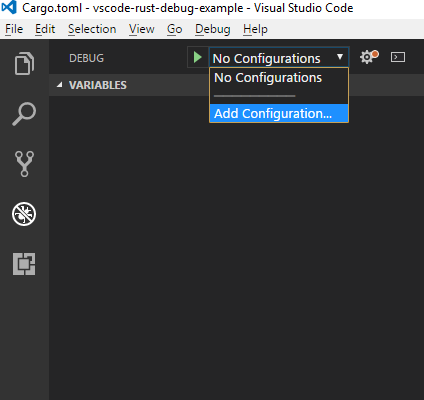
When you run an app under the debugger for the first time, you'll see a dialog box saying 'Cannot start debugging because no launch configuration has been provided'. Click OK to see a second dialog box saying 'Cargo.toml has been detected in this workspace. Would you like to generate launch configurations for its targets?'. Click Yes. Then close the launch.json file and begin debugging again.
As you can see, the debugger breaks at line 2. Press F5 to continue, and the app runs to completion. In the Terminal pane, you'll see the expected output 'Hello, world!'.
Rust for Windows
Not only can you use Rust on Windows, you can also write apps for Windows using Rust. Via the windows crate, you can call any Windows API past, present, and future. There are more details about that, and code examples, in the Rust for Windows, and the windows crate topic.
Related
I recently wanted to debug a Rust program on Windows that I had written, and was struggling with how to get it to work. Download install gtalk torrent. Since there was quite a lot of hoops to jump through to get it to work, I though I should share it with other people as well. I've written this blog post from memory and I'm far from an expert in LLVM or Rust, so if you see something strange here then let me know.
The drawback of this approach is that you can't debug applications built using the MSVC toolchain. If you know how to do this, please tell me. I would really appreciate it.
UPDATE 2018-02-02:
As Stuart Dootson pointed out to me, there's a guide on how to debug applications using the MSVC toolchain here. I haven't tried this out myself, but it looks promising. Thanks Stuart!
1. Install LLVM
First we need to install LLVM which is a compiler infrastructure. Part of LLVM is LLDB which is the debugger we're going to use. The latest version of LLVM doesn't include Python support for LLDB which is required for the VSCode extension, so we need to download a custom built version and install that.

Rust Visual Studio Support
2. Install Python
We now need to install Python v3.5 (Not v3.6).
https://www.python.org/downloads/release/python-354/
If you installed the x64 version of LLVM, make sure that you install the x64 version of Python as well, otherwise you will encounter problems later on.
3. Make sure it works
Make sure that lldb can use scripting. If this doesn't work, make sure that both LLVM and Python is on PATH.
Write exit() to close the Python interpreter and then CTRL+C to break out of LLDB.
4. Install the VSCode extension
We now need to install the vscode-lldb extension for Visual Studio Code. This is what makes it possible to debug our Rust code from Visual Studio Code.
https://marketplace.visualstudio.com/items?itemName=vadimcn.vscode-lldb

Visual Studio Basics
5. Install the Rust GNU toolchain
Rust Visual Studio Code Linux
Since LLDB doesn't work with the msvc compiler, we need to install the Rust GNU toolschain and use that one. This have some drawbacks though such as we won't be able to intop with software produced by Visual Studio.
6. Set the active toolchain
Visual Studio Code Rust
We now need to set the Rust GNU toolchain as the active toolchain. We do this by using the rustup command again.
We should now verify what our toolchain configuration look like by using rustup show.
7. Create a project
Create a new project called hello_world.
Open Visual Studio Code and go to ./src/main.rs and place a breakpoint.

Rust Visual Studio Community
8. Edit launch.json
Press F5 to run the project. A selection box will appear that will ask you what environment you want to use. Choose LLDB Debugger here. This will open up the launch.json file, and here we need to tell Visual Studio Code how to launch our project. Edit the file so it looks similar to this:
Vscode Rust
9. Profit
Rust Visual Studio 2019
Press F5 again. You should now be debugging your code.